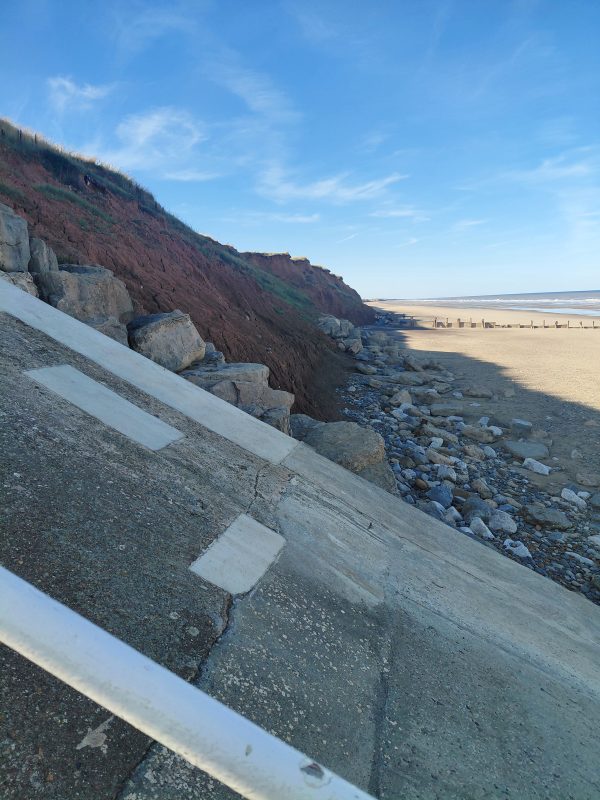
At the northern end of Withernsea’s concrete promenade and granite boulders is a flight of stairs from the beach to the top of the promenade. Beyond this some boulders were deposited (see above) but it is surprising how little coastal erosion there has been north of these. There was some expectation that reinforcing bits of a fast eroding coast would increase coastal erosion north and south of these points – Hornsea, Mappleton and Withernsea. To an extent this has happened at Mappleton, but not so much at the other two.
As with constructing dams and weirs, the building of a promenade must involve some form of temporary structure to hold back the high tides so concrete can be poured and harden at least. The southern end of Withernsea’s concrete promenade was constructed only about 20+ years ago, but I did not study developments there at that time.
Sand is the ultimate product of marine abrasion, a grain of sand was once part of a stone. The sand then is the top covering of a bedrock of some sort. The bedrock pitching eastwards at Withernsea is a thick chalk strata, but above that are layers of semi-compacted impervious boulder clay resulting from glacial deposition. There was once a storm that stripped the sand from the beach at Withernsea leaving visible a layer of hardened boulder clay so smooth that it was impossible to walk upright on and access to the beach was prohibited for safety reasons. The beach was later ‘primed’ with loads of fresh sand.