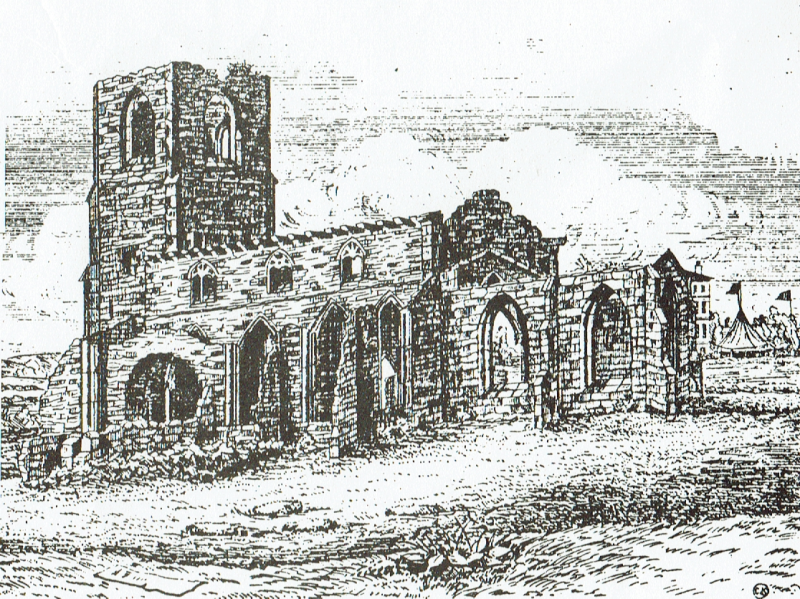
Today’s image is a drawing of the parish church at Withernsea, date uncertain. Withernsea’s original early medieval church was destroyed by coastal erosion in the 15th century. In 1488 a new replacement church was opened further inland. This church remains in pretty good condition although in 1609 its roof was ripped off in a violent storm and it stood semi-derelict for a long time. This church was restored at the expense of Bannister (s.p.b.) and the Railway Company soon after the rail line was completed. Bannister rightly believed that decent holiday makers would expect to have a church available for Sunday worship. Cuthbert Brodrick (s.p.b.s) oversaw the repairs. Part of the funding came from the sale of a book printed in 1858 entitled ‘Withernsea’ and written by a Rev. Gatty (I know no more on this). The church, St. Nicholas, patron saint of sailors as well as children, stands today in good condition, but disused.
The rail line to Withernsea was given Royal Assent in July 1853 and first opened in June 1854 – a remarkably quick time in which to build a railway, although the Holderness landscape didn’t present too many obstacles. The rolling stock included carriages for passengers, freight wagons and trucks to transport farm animals. Four trains left Hull’s Paragon station each day and there were four return trains, the journey usually took slightly less than one hour, a bit quicker than the modern bus journey. A turntable at the ‘end of the line’ allowed engines to be turned round for the return journey. The Eastern Counties Herald (newspaper) reported on 26th June 1854 that the inaugural train left Victoria Dock station (s.p.b.s) pulling 30 carriages. The inevitable ‘luncheon’ included sufficient food to overwhelm all but the most gluttonous of guests. Toasts were offered to the Queen (Victoria), Prince Albert, the Archbishop of Canterbury the Army and the Railway – a most respectful rank order!
(to be continued).