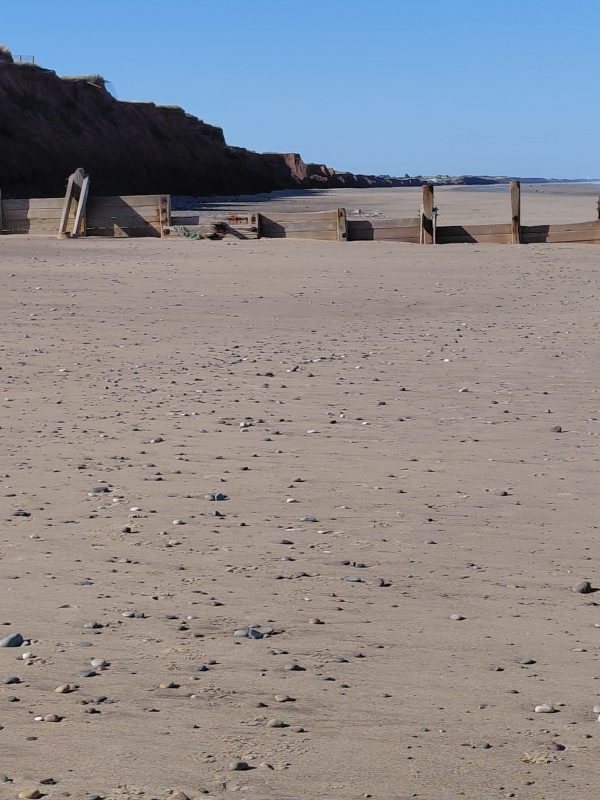
This photo shows the cliff line immediately north of the concrete promenade at Withernsea. Crossing the fields to the east of their hamlets the people of Owthorne and Withernsea in the 18th century, for example, (s.p.b.) would have had to create some safe way of getting down to the beach to collect stones rounded by marine abrasion to use as walling material in their cottages, or if repairs were needed. One example of such rubble walling remains in Owthorne. The settlements had no history of inshore fishing (unlike at Cleethorpes for example) so the people then had no culture of being attracted to the beach, except, perhaps, for meditative individuals.
The first railway station at Withernsea must have seemed rather like a terminus, but no terminus, for people from Hull accustomed to living in high density courts and terraces, but the fields and clifftop certainly made a change. Some buildings of the railway station survive and alongside is a large building funded by Bannister in the late 1850s as a hotel to encourage more prosperous visitors on the train. Like the station, it was designed by Cuthbert Brodrick designer of Hull’s first town hall and many other buildings including the Grand Hotel, Scarborough. Brodrick is commemorated in Pearson Park, Hull near to his ‘cupola on the hill’.
It was in the early 1870s that Bannister and Brodrick planned an architect designed seaside resort in the hope of it becoming the ‘Brighton of the North’.
(to be continued)