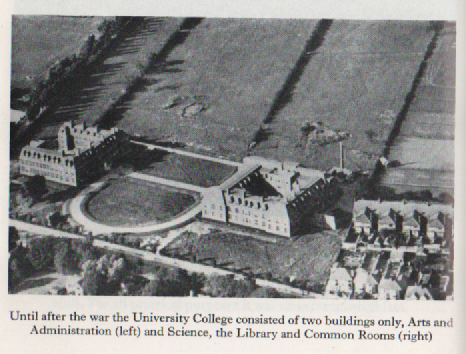
This aerial photo was scanned from Bamford, T.W. The University of Hull, the first Fifty Years (Oxford University Press, 1978, p.23). It shows the buildings that comprised Hull University from the late 1920s to the 1950s when further building took place. The buildings shown survive facing Cottingham Road with building top-left now called Venn building on mostly administration offices, while the building on the east side still has some teaching rooms, including Geology. The arched driveway no longer exists, with the modern main entrance leading to Middleton Hall which now stands between the two older buildings.
After the Second World War the building complex extended north across the three post-enclosure fields shown at the top of the photo. At the bottom right can be seen a section of the houses on Salmon Grove, these built in a late-Ats and Crafts style and which in the 1930s had tennis courts across the road; these probably much used by University staff. This area has now had built on it a section of the on-site student accommodation, with a nearby information board explaining the drainage system across the campus is designed to avoid surface flooding such as last scene in 2007.
Incidentally, a staff photo taken in 1928/’29 and included in the book (p.55) shows 47 persons with the majority of the men sporting university gowns while the 11 female staff were gownless.
The then Duke of York (later king George VI) is shown in another photo laying the foundation stone of the new university college on 28/4/1928.
It would be hard to over-estimate the importance of Thomas Robinson Ferens in establishing the University. In a letter dated February 1925 he expressed a willingness to donate £250,000 to form a ‘nucleus of a University College for Hull’. As he was to do at East Park and elsewhere he was prepared to buy the land, thus saving any organising committee that heavy capital burden.