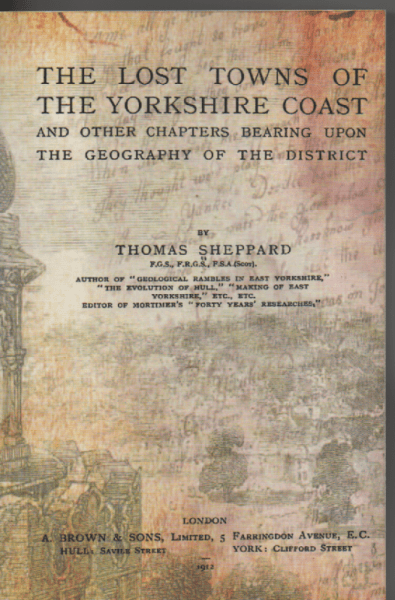
Above is the cover page of a reprinted book first published in 1912. The author ‘Tom’ Sheppard was the first curator of Hull Museums located on Albion Street in a large building, never rebuilt after being bombed in 1943. A large volume of the exhibits were also destroyed, for example the long log dug-out canoe, thought to be Neolithic or earlier, found in the anaerobic muds of the River Ancholme in the early 20th century (maybe 1890s).
The occasion of the public talk I went to hear today was the annual Chris. Ketchell Memorial Lecture, given in the nave of Hull Minster (Holy Trinity) by Mike Horne F.G.S. Honorary Research Fellow, University of Hull. The presentation was about Thomas Sheppard with particular reference to Sheppard’s geological studies in East Yorkshire and resulting publications. Th presentation was thoroughly illustrated and very informative. One of the angles of Mr. Horne’s presentation was Sheppard’s dubious reputation as a collector/thief(!) of artifacts found elsewhere for display in Hull Museum, particularly in north Lincolnshire, then the county of Lindsey. There is ample evidence (I words, not Mr. Horne’s) of Tom often crossing the Humber on the steam ferries to New Holland, visiting sites of interest, particularly archaeological digs, and arranging for the transport of items back to Hull. He knew the region well having been brought up in modest circumstances in South Ferriby. Having left the village school (surviving) at the age of 13 he progressed in life by developing his interests and working at a number of jobs. He was clearly not slow in coming forward.
To be fair, in the 1920s I don’t think there were proper museums in Scunthorpe, Grimsby, Barton or Brigg, and anyway these were in the ‘thirding’ of Lincolnshire called Lindsey with its hq in Lincoln, a place far away and loath to spend public money on all but the bare essentials.
Sheppard published many papers while Curator of Hull Museum and a few books including the one shown above. His critics claim that even here he may have been plagiarising an earlier unpublished work. If this earlier work was George Poulson’s ‘History and Antiquities of Holderness’, published 1840, and he must surely have had copies, then he was using the researches of others without crediting them, arguably a form of plagiarism.