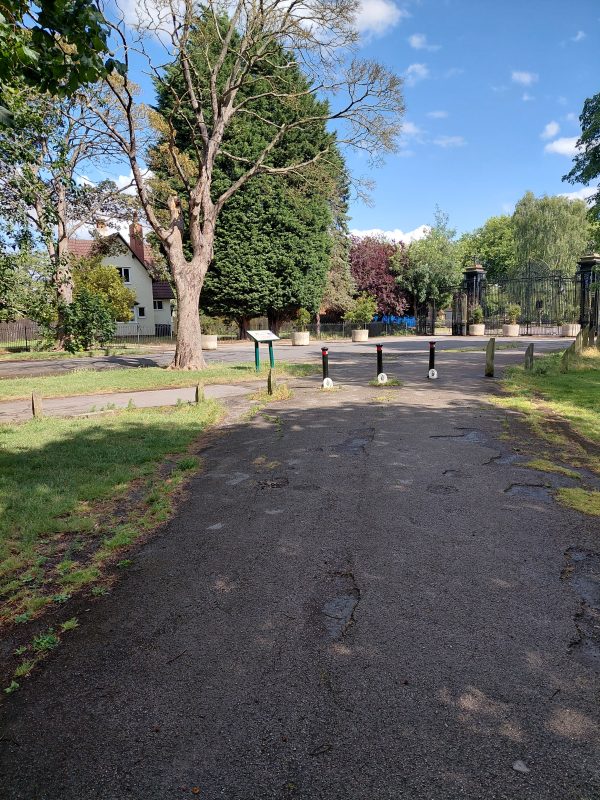
The above photo shows just inside the park gates at Pickering Park (s.p.b.). The main carriage gates seem to be permanently shut these days, the side pedestrian gates open. Mr. Pickering was quite happy, it seems , for the main carriageway to be used as a way-through between Pickering Road (not then so named) and Hessle Road; but this would then (1914) have been for horse drawn farm carts or private horse drawn carriages. Priory Farm was sited just across Hessle Road from the Park gates until well after the Second World War and had been one of the out-village (post-enclosure) farms of Hessle Common; emphasising the fact yet again that municipal parks and cemeteries had to be initially located beyond the City itself, later to be surrounded by suburban development.
The house seen in the photo was completed by 1911 (I think), in that year a job application was advertised for a ‘Park Foreman’ (defined elsewhere as ‘Park Keeper’). Later that year a man was appointed, plus three gardeners and six labourers. The ‘Superintendent’s’ house (a later phrase) was a fine detached house with at least three bedrooms and in a simple Arts and Crafts design then fashionable. It cost the Corporation a considerable sum to build and the Superintendent and his family got it rent free – so long as he kept the job. The house helped attract quality candidates, generally experienced in park organisation and often from various parts of the country.
In 1912 the councillor members of the Parks and Burial Committee of the City Corporation add Pickering Park to their annual park inspection, now four in number : Pearson Park (by then 50 years old), East and West Parks (by then 20 years old and, now also, Pickering Park. They were generally well pleased, but on this occasion their conclusions were not recorded in the Committee minutes.