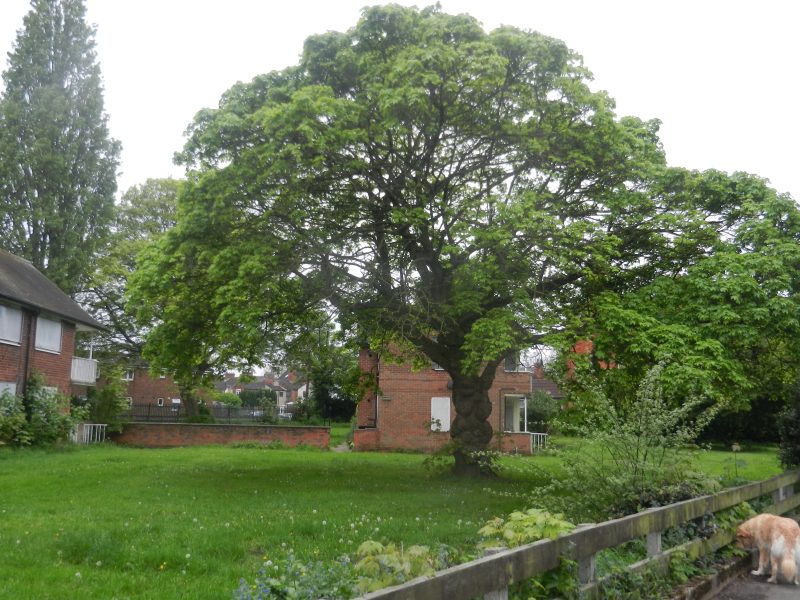
The above photo shows a remarkable maple tree, originally planted in front of Lime Villa (demolished), Pearson Park, Hull. Part of Henson Villas is shown behind, these buildings now awaiting demolition. Also showing a Lombardy poplar on the far site of the site, this probably planted for Malvern House (demolished 1938). This tree is remarkable because it comes into leaf so early, late March this year, late February last year. It is an example of a tree that has not had to compete with nearby trees for sunlight, photosynthesis.
On the guided walk last Saturday to study the original East Park we discussed the avenues of trees, mostly horse chestnuts, planted in Hull parks and how far apart each was planted to give each trees a chance to flourish without too much competition, but still creating an overhanging avenue. We decided on about 40 feet.
This is reminiscent of hedge planting after parishes were enclosed by Parliamentary Enclosure c.1750-1850. Here often young deciduous hardwood trees were planted to give the landscape diversity and provide some shelter in pastureland. This planting in much of eastern England created a populist image of the countryside; now all but a few have gone, sacrificed to efficient modern farming. How far apart were these trees planted? Distances would have varied parish by parish, but the distances would have been greater than in the parks as no avenues were planned. However such hedgerow trees, like the one above, grew tall, sturdy and with a rounded canopy because they did not have nearby competition. Such a loss.