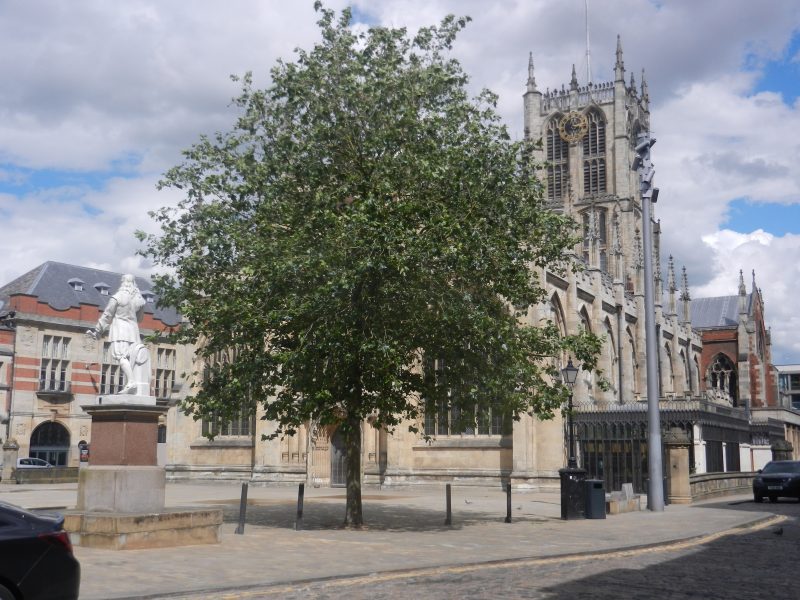
This photo of a young plane tree in Minster Square was taken a couple of years ago. As far as I know Andrew Marvell (see above) made no reference to plane trees in his writings; this not surprising as plane trees are not native and were only introduced to Britain roughly when Marvell was alive, (1621-1678), probably from the Middle East.
Plane trees are deciduous with lobed leaves similar in shape to those of sycamore trees and maple trees, they all being in the same species family.
Plane trees are a very common choice by local authorities when young trees are needed for a city environment. They have a reputation for surviving in areas of heavy air pollution; although if the emphasis is on planting native species this will not be the case.
Plane trees have two easy to identify features – the seed pods are round, brown with a hairy skin (not to be confused with conkers, which are larger), and the bark of the trunk often seems to be flaking off revealing undercoats of varying pastel shades.
Like limes and sycamore for example, plane trees can grow very large, sometimes over 100feet in height and spreading.
Their natural habitat spreads a wide band across the Northern Hemisphere from Asia to Western Europe. The British maritime climate might seem hostile to the specie but it has adapted well and will probably benefit from climate change.
In Hull there are examples of young trees near the Tidal Barrier but the best place to see mature, probably old mature, is along either side of Cottingham Road, north Hull. There are particularly impressive specimens in front of Macdonalds at the road’s west end. Plane trees were not a popular species for planting in municipal parks in Hull.