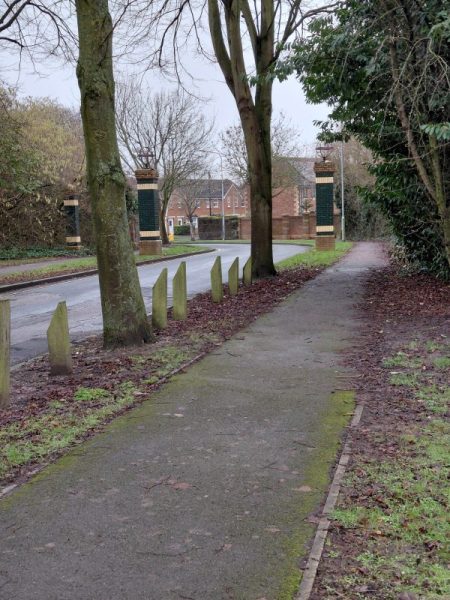
Recent afternoon’s walk. Light rain forecast, but held off (unusually for this winter), at one point thought I saw a sliver of blue sky but may have been a mirage. Started Cleveland St, opposite Tesco Express and walked north along a surfaced path (foot and cycle) with wide grass verge to west plus trees and at one point allotments on opposite side. Came tp a large open grassy area known, I am told, as Rockford field. This grassland use to extend further north until a new private housing estate was built. The photo above shows the entrance road off Leads Road (this taken on a previous occasion) with these interesting/pretentious entrance gate pillars and footpath pillars. Must be a story here?
Took the unsurfaced footpath across the field and started to walk east along a section of what, until 1965, was the track of the Hull-Hornsea Railway. Here path/cycleway has linear green corridors either side with a variety of generally young/mature trees and shrubs. Crocus, snowdrops and celandines closed in the absence of sunshine. Walked under Sutton Road bridge and on to Tweendykes Road, Sutton. As the path ahead through the cutting was flooded went along Highfield Road to get to central Sutton. At first I thought how nice it was to see most front gardens planted, but it didn’t last and in fact most were hard surfaced to get the car near the front door.
St. James, Sutton is a fine, large church dating from a time long before any physical connection with Hull. However, like Holy Trinity, Hull the building fabric is mostly 14th century brick with the brick west tower and the extension of the nave aisles either side of it a bit later. The chancel is entirely of freestone. Normally open to the public only in Heritage Week (I think) and at times of services.
Sutton village stood/stands on a linear ridge which resulted from glacial deposition towards the end of the last Ice Age. This ridge, arcing from Wawne to Paull is claimed to be why the Humber Estuary does not have the normal horn-shape outline of an estuary, the waters being diverted south-east by the ridge, hence the dogleg.
The Hull to Hornsea railway, 1862 – 1965 was an offshoot of the earlier Victoria Dock Railway with 11 village stations between Wincolmlee, east Hull and Hornsea. Most of the housing passed on the walk above post date the closing of the railway but a few post-war (1950s) houses may have witnessed the last steam trains on the line.