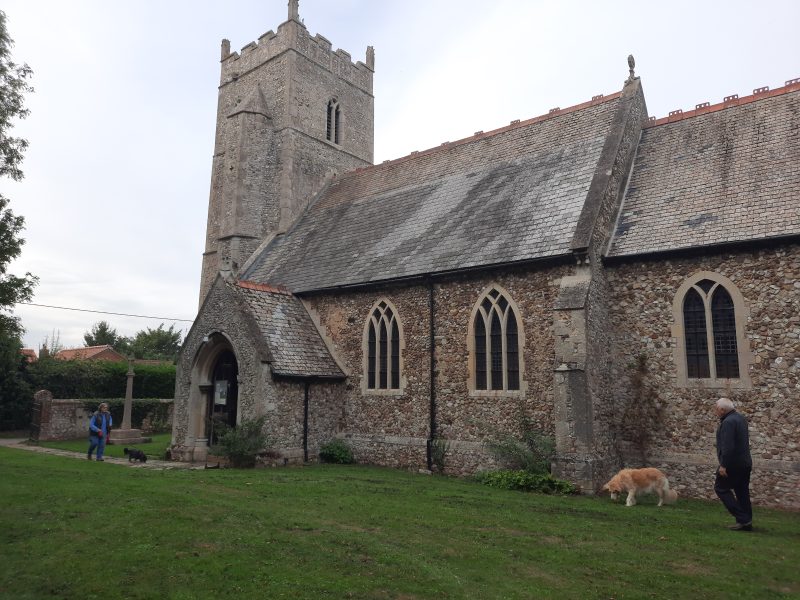
My photo of the south walls of All Saints church Boughton (taken two years ago) shows clearly the Y tracery and intersecting tracery of the new windows 1872. The replacement roofing material not pantiles but North Wales slate, readily available nationwide by 1870. The three-stage buttress at the south-east corner of the nave looks very similar to the one shown in Ladbrooke’s lithograph.
Without further evidence a rebuilding of nave and chancel after a serious fire would almost certainly point to a thatch roof catching fire. But, as we see from Ladbrooke’s image All Saints did not have a thatch roof c. 1830. Thatched roofs are prone to burn if ignited by something. Ironically the better constructed by the thatcher the more vulnerable to fire as the underside of the roof remains dry, on a poorly thatched roof the underside of the thatch eventually becomes saturated and thus more fire resistant.
At first sight it seems hard to think how a stone built building could burn down. In fact it is possible for lime mortar to smoulder if it has a high content of chopped straw. But a more likely sequence of events is the wood beam frame of the ceiling supports catches fire, smouldering at first and bursting into flame once a certain heat is attained. Once embers fall to the floor they can ignite wooden church furnishings such as pews, pulpit, chancel screens, reredos, choir stalls etc, if such exist. Excessive internal heat inside compared with the outside temperature can compromise the stability of external walls. Interestingly the fire at Notre Dame cathedral, 15/4/2019 was largely contained within the roof space as the stone vault of the ceiling largely held back this potential sequence of events.
Wikipedia informs us that York Minster had suffered four major fires between 1753 and 9/7/1984 when the south transept was all but destroyed by fire. The follow-up investigation concluded that the Minster fire was most likely caused by a lightening strike which somehow penetrated the roof space; this more likely than the explanation given by some weirdo clerics that it was divine retribution for a controversial promotion in the hierarchy of the Established Church.
Causes of past fires have been: electric short circuiting (20th century only), worker’s negligence e.g. leaving lit candles after work or such like and arson. Any of these could start a fire on the ground floor.
I do not know what caused the fire at Boughton church c.1870.
(to be continued)