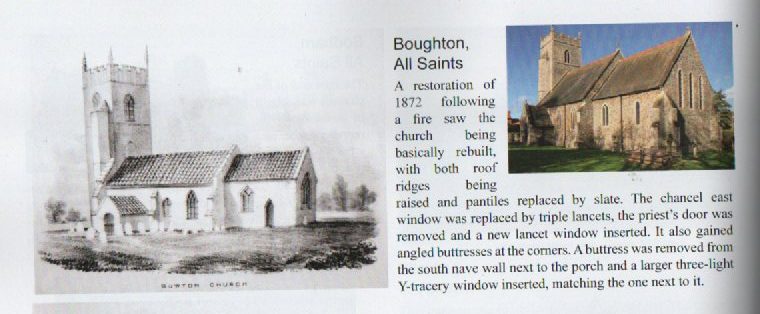
In the book Hinton, Ian Ladbrooke’s Church Lithographs, Journal of the Norfolk Historic Buildings Trust, Vol. 8 (2025) all the lithographs produced by the father and son team in the 1820s/’30s, 600+ in total, are reproduced along with a modern photo taken from the same angle (as far as possible) and a few history notes; Boughton’s (s.p.b.) is shown above. This is of particular interest as I had never seen before any image of the pre-restoration church. The surviving late medieval west tower, with its encased external spiral staircase, was clearly not radically impacted by fire of c. 1870 which led to the rebuilding of nave and chancel.
The rebuilding resulted in the keeping of a Y tracery window in the south chancel wall (matching the belfry window), but with no replacement for the priests door and a replacement stark lancet window, matching the three at the east end. The new walls and roofs after 1872 were built much higher than those shown in Ladbrooke’s lithograph, in the case of the nave conforming to an earlier medieval roof line just visible in the lithograph. It is not clear what the walling material was in c.1830, and possible the walls had been rendered and whitewashed. The replacement walls are mostly coursed flint in heavy lime mortar; quite possibly the flint stones were reused from the earlier church. Interestingly the roofing material c.1830 appears to be pantiles (Dutch tiles), Hinton stating on p.72 that pantiles, although originally imported from the Low Countries, a county pantile making industry had developed, adding ‘pantiles were more popular in the 1820s than they are now. In 1820 217 churches used pantiles, including 73 on both nave and chancel’ as seen above.
Which brings us to the issue of fires in churches.
To be continued.