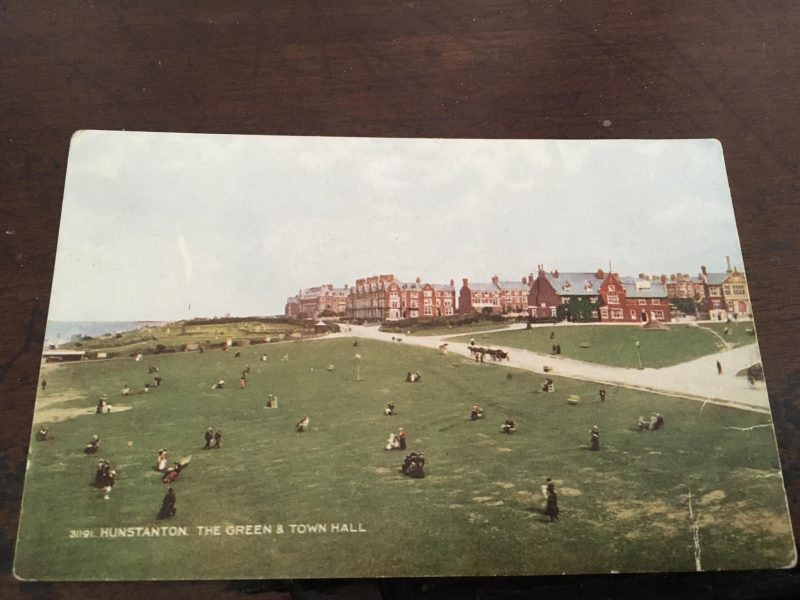
Today’s photo is taken from n old postcard showing the ‘Green’ (surviving) and buildings to the north, most of which survive. The local red brick reflects the iron content of the local topsoil clays as do the cliffs seen in the previous blog. Beyond the Green are the municipal gardens, more horticulturally interesting now than then. These gardens and the green sward beyond stand at the top of the cliffs seen in the previous blog.
South-west Norfolk is characterised by an undulating landscape as previously explained. The scarp slope of the East Anglian Heights in this area overlooks the Fenlands to the west. In Downham Market Bridge Street threads down this slope to the railway station (Kings Lynn, Ely, Cambridge, London) and the River Great Ouse, both of which run along the base of the scarp slope, must like the lower River Trent at the base of the scarp slope of the Lincolnshire Heights (limestone bedrock).
From somewhat higher points across the undulating landscape expansive views may be had in fine weather. It is interesting on such days to try and pick out church steeples that may be visible. In total Norfolk has more parish churches than any other county in Britain, so it is the a county prized by ecclesiologists, these days most incumbents (usually having group circuits anyway) and churchwardens understand that a visitor can be interested in the church as an historic building primarily, rather than just the local place of worship; although, of course, Church history is vital to an understanding of the building. There have been a number of well respected studies of Norfolk churches, e.g. the three-volume study by D.P. Mortlock and C.V. Roberts, published 1985 (sounds overwhelming, but it isn’t, published parish by parish). I have recently discovered that a study has just been published of Robert Ladbrooke’s lithographs of 700 Norfolk churches, mostly of the 1820s and 1830s. Apart from their innate interest they provide evidence of many medieval churches before the Victorian ‘restorers’ got hold of them. Apparently the originals are scattered across many different owners and it is typical of Norfolk County Council to let it stay that way.
(to be continued)